Pages

Showing posts sorted by relevance for query productivity. Sort by date Show all posts

Tuesday, May 24, 2011

The Key to a Successful Social Business is Social Everywhere

View Comments

The keyword 'social' is undoubtedly top of of mind for many people. It seems it's harder and harder every day to go by without hearing the words Facebook, Twitter, and LinkedIn in your job, in the media, in the bus, in the subway, or wherever else you go. Hollywood has even taken this to the big stage with the movie The Social Network . And while the words 'social' and 'social software' may come up often, they could mean different things to different people. Some think of 'social software' as a way to waste time. Others view it as a way to collaborate with friends and peers. Others see it as dangerous because it makes content sharing too easy.

Nevertheless, consumer social networking sites such as Facebook are widely considered a success for its power to connect people and make it easier to market products. It begs the questions

  • "Is there any value to bring social collaboration technologies into my Enterprise?"
  • "Can I use Web 2.0 technologies inside the firewall to effectively transform my organization into a Social Business?"

This entry describes the importance of social technologies to your organization, common challenges faced when deploying these, the importance of a 'social everywhere' strategy and what tools are available to achieve this mission.

Why Is Social Important To Your Organization?

This past decade has been a difficult one on many fronts. Starting in 2001 the global economy has suffered and it's just now showing some signs of recovery, though painfully slow. Businesses have found themselves trying to rapidly adjust to the market demands. Some of those businesses have found, however, that they are not agile enough and can't adapt as fast as they would like to respond to emerging opportunities. It's time to take action and position your organization for growth as the global economy slowly comes out of its downturn.

The following sub-sections describe steps to take to position your company for growth.

Step 1: Accelerate Innovation - Increase Productivity

In order to position your organization for growth, we need to understand what are they key areas to focus on. An imperative way to drive growth is to accelerate innovation and ensure that you innovate faster than your competitors. Apple is a great example of this. They've seen huge success in the last 3 years because they've innovated a lot faster than their biggest competitor: Microsoft. While Apple still has a lot of work to do to catch up on market share, their revenue and profit numbers are certainly impressive. Apple has also been able to surpass Microsoft and has become the biggest technology company based on market capitalization.

In a survey of global CEO's, 98% of those CEOs said they need to restructure the way their organizations work. 5.3 hours are wasted per employee per week due to inefficient processes. Additionally, two hours are spent per employee per day looking for the right information and expertise within an organization.

Often times, information within an enterprise lives in silos. Therefore, the usefulness of this information is not maximized across the organization. Many companies have deployed team sites in the hopes that employees would dump their wisdom in these sites. However, each part of the organization, down to the department level, uses different places for document storage. This leads to fragmentation of the corporation as a whole and it means that employees must do a lot more work to individually search across these information silos. Inevitably, this leads to employee frustration and because they can't find the information they need, they need to "re-invent the wheel" and recreate the intellectual capital which already exists.

This is the where social software for the enterprise first comes in. Social software inside the enterprise helps accelerate innovation and increase productivity. The Australian Bureau of Statistics, for example, deployed IBM social software to bring speed and effectiveness to the organization.

Step 2: Rapidly Develop Workforce Skills and Capabilities

IBM recently released the 2010 Global Chief Human Resource Officer (CHRO) Study. The study highlights major challenges faced by organizations that could prevent growth. One of them is ensuring that the right employees with the right skills are allocated to the right projects. In fact, organizations classified as financial outperformers are 47% more likely to rate themselves as effective in workforce allocation.

Additionally, CHROs feel there are three critical capabilities they need to provide but feel its beyond their ability to achieve: developing future leaders, rapidly developing workforce skills and capabilities, and fostering knowledge sharing and collaboration. There are various reasons why CHROs feel they are not able to address this, as cited in the study:

Embedding creativity, agility, and speed, however, won't be easy. A number of boundaries -- functional, cultural, geographical, generational, and informational -- constrain workforce productivity and prevent enterprises from realizing their full potential. Organizations must overcome these borders to address emerging opportunities, whenever, wherever, and however they arise.

At the employee level, it's often left up to the employee to do self training or figure out which courses to take. Companies also struggle to both find and nurture effective future leaders. A U.K. HR director said "Our leaders currently rise to the top by chance, not design. We need to foster talent." Try as they might, organizations don't have a clear view of who's who in an organization.

Social software behind the firewall is the right solution in this case. Whether users decide to blog, write wikis, share files, participate in discussion forums, join/participate in communities, their intellectual capital is captured in one single place: their profile. This profile is fully searchable and discoverable making it easier to identify individuals for the right job. At the same time, employees can effectively learn from each other and discover topics that they may be interested in and even career opportunities that best match their interests, skills, and capabilities. This informal learning (also called social learning in the enterprise) is critical to empower employees to rapidly develop the skills they need for the job they want.

Sogeti, a Capgemini subsidiary that specializes in technology services, deployed IBM social software because it wanted to ensure that its consultants had the right skills for the projects they needed to staff. Additionally, it made it easier to identify the consultant that had the right skills and experience for a particular project.

Step 3: Break Down Existing Silos

For some time now, organizations may have been following knowledge management principles where everything is tightly controlled and centered around documents. Individual business units, departments or divisions may have chosen their own way of collaborating around documents. This often means different technology products sitting disconnected from the rest of the enterprise, and perhaps not even accessible by everyone in the enterprise.

Organizations need to develop the infrastructure and, perhaps most importantly, culture required to stimulate innovation and enhance operation efficiency and effectiveness. The 2010 Global Chief Human Resource Officer (CHRO) Study clearly concludes that the best way to achieve this is by encouraging the formation and use of cross-organization communities around strategic business topics, solicit and recognize fresh insights and new thinking from internal and external sources, and create value through the systematic capture and reuse of individual work outcomes.

Cultural and organizational silos often compromise the ability of companies to share information across functional boundaries. A senior vice president of HR of a North American company said: "We need to know our stuff and be self-reliant, to solve problems cross-functionally and to fully leverage our talent and ideas".

An enterprise-wide social collaboration platform can easily break down organizational and collaboration silos and unite your workforce. It can give your workforce the tools necessary to form and track communities of practices, share and re-use intellectual capital, and lead idea capture. Additionally, it can even break down the barriers between employees and customers. Sennheiser, a leading manufacturer of headphones, microphones, and other audio equipment, recently deployed IBM social software to more effectively connect the workers across the organization. The platform enabled the company to build a single global collaboration solution among customer support representatives, audio engineers and global experts. Using the solution, the company started to build a single knowledge base. Team members can now instantly access detailed information about a performer’s equipment requirements and a venue’s technical specifications. Global RF specialists exchange their knowledge, ideas, and suggestions over blogs and wikis.

Common Enterprise Challenges with Social - If You Build It, Will They Come?

A key challenge here is determining who has ultimate responsibility for driving information sharing within an organization to effectively break down these information silos. Dion Hinchcliffe, founder and chief technology officer for the Enterprise Web 2.0 advisory and consulting firm Hinchcliffe & Co, recently wrote that it doesn't have to be a C-level executive. However, he does emphasize that while strong executive leadership is a key success factor, it's really critical that a group of forward-thinking leaders from across the organization get together and drive the organizational and culture transformation:

It really takes a village, or more properly, an forward-looking organization that is trying to recalibrate itself around the way that the way that the world seems to be shifting. That shift, the fast-moving and global world of sharing, participating, and openness that is social media at its finest, is one in which smart organizations will pull together their best internal leaders to proactively make themselves better. This will get the ideas, innovation, and knowledge into the right places at the right times to the benefit of customers, shareholders, and ultimately, you and I.

Hinchcliffe is not alone. According to CMSWire, the biggest challenge in transforming your organization into a Social Business is adoption.

You can't expect to build a Social Business solution and pray to the gods that employees will use it. It just won't work. As stated above, Social Business aims to break down silos, connect employees, and increase productivity and this is only achieved if the employees believe and use the system. Social Business is about leveraging the wisdom of the crowds. Social Business is about leveraging each other's work and ideas. Without people, the system breaks down.

Questions to think about:

  • What can I do to engage users on day 1?
  • What can I do to keep users engaged?
  • How can I increase trust in the system

Importance of Social Everywhere

Today's workers are under extreme pressure to meet deadlines. It's unreasonable to expect that they'll have to take the time to learn new tools and figure out ways to incorporate it into their business process. Therefore, it's essential that these new collaboration technologies are weaved into existing business processes. If employees can collaborate from their existing tools without needing to open a browser, sign on, and consume/share content separately then it's more likely that the employees will participate more and rely on it. You want to drive your employees to social software, not away from it.


In real estate, it's all about location, location, location. When considering a Social Business deployment for your organization, you must think about integration, integration, integration. Think about this: where do your employees do most of the work? In e-mail? Mobile? In spreadsheets? In documents? Most likely, your employees are creating intellectual capital and doing their day-to-day tasks in a particular application that's not the browser. Therefore, why not bring the tools to the employee instead of waiting for the employee to come to the tool?

CMSWire recently published an article where it highlights the importance of integrating your Enterprise 2.0 solution with existing tools and processes.

Enterprise 2.0 tools don’t live in a vacuum, in fact, far from it. They have to be integrated within the fabric of your organization as it exists today. [...] You might think that you can roll out an Enterprise 2.0 tool without integrating it anywhere or with anything. However, beware of creating an information silo (or additional information silos).

Consequently, Social Everywhere is important because it will:

  • make the best-of-breed collaboration tools available to all employees everywhere, anywhere, anytime
  • make it easier for your employees to collaborate, share and re-use intellectual capital
  • help your realize value from an organizational transformation faster
  • keep end-users engaged
  • simplify the process of exchanging information
  • bring the tools to the end users
  • create trust
  • increase productivity

In all, a Social Everywhere strategy is about driving and sustaining adoption which accelerates the rate at which ROI is achieved and surpassed.

How to Drive Social Everywhere

IBM's Social Collaboration Platform is ideal to drive the social everywhere strategy you need. Ever since it was made available to customers 4 years ago, it has focused on integration as a key method to drive and sustain adoption. Through it's App Catalog, IBM currently provides integration plug-ins for:

It's critical that you don't forget about your mobile workforce. These are probably the first to realize value from a Social Business solution. IBM's Social Collaboration Platform is accessible via mobile devices such as the iPhone, iPad, and Nokia S devices, and the like without additional plugins. RIM provides a native application for BlackBerry devices. ilionx has built a native iPhone / iPad application for Connections.

The following images show some of the integration points available today for free.

Figure 1. If your employees are already connected to your portal, then you can surface IBM Connections directly in their context

Figure 2. Microsoft SharePoint surfaced within IBM Connections where you can upload and download files directly through IBM Connections which effectively destroys those Microsoft SharePoint silos you have.

Figure 3. Bringing IBM Connections content to Microsoft SharePoint

Figure 4. IBM Connections available on your mobile device

Figure 5: Microblogging from your email client

Figure 6: Sharing documents directly from Microsoft Word

The integration points provided by IBM's Social Collaboration Platform are endless and it's impossible to cover all of them in this entry. Hopefully, this provides a sneak peek into all the integration options available which will be key to drive and sustain adoption of your new Social Busines platform.

Conclusion

In adopting IBM Connections technology, the ABS is in very good company. Over 35% of Fortune 100 companies have also adopted IBM's social software offerings.

According to the IDC Worldwide Social Platforms Revenues by Vendors, 2007-2009, June 2010, IBM was named the worldwide market share leader in the Social Software Market, which includes IBM Connections. The IDC report states that worldwide revenue for the social platforms market was $369.7 million in 2009, representing growth of more than 55 percent. Gartner has classified IBM's social platform as a Leader in their Social Platform Magic Quadrant of October 2010.

Thus, if you are ready to transform your company and get it ready for the new growth opportunities in this new decade, look no further than at IBM's Social Collaboration Platform.

Thursday, September 8, 2016

The Office of the Future: Automation and Innovation in the Virtual Workplace

View Comments


The workplace is changing. Although the physical office can still be a place of productivity and collaboration, companies are empowering the individual worker by providing all the tools necessary to be a valuable member of the organization from any corner of the globe. Today’s workforce is becoming increasingly flexible, mobile, and even global in nature — virtual collaboration is at the center of the workplace and shaping the way businesses operate now and for the foreseeable future.

The strong influence mobility has had on the workplace can be found at the epicenter of this shift. As smartphones and tablets have become rooted in our personal lives, workers have found these devices to be beneficial in facilitating their work responsibilities as well. As a result, many employers have embraced the Bring Your Own Device (BYOD) trend to foster collaboration among employees outside the office. The introduction of mobile devices in the workplace has deeply affected the way people work as they increasingly rely on their personal smartphone and tablet for email, note-taking, and video conferencing. Since BYOD policies have allowed workers the flexibility to conduct regular business from even the most far-reaching areas around the world, the need to confine work between the four walls of an office has decreased, depending on the company, driving further adoption among telecommuters.

The same factors that are driving companies to downsize their physical office spaces has resulted in the rise of temporary contractors as an alternative to full-time employees, thereby creating the need for secure collaboration apps with functionality spanning across corporate firewalls. Advances in mobility and Internet-based technologies have enabled employers to connect with individuals willing to work on a short-term basis without needing to be located within the same time zone. By breaking down the geographic boundaries that have historically limited organizations to a select pool of qualified candidates, mobile devices and collaboration apps now allow independent employees to hit the ground running and remain connected to their working groups from anywhere in the world. The opportunity for employers and hiring managers is compelling, as the potential size of talent pools multiplies significantly. In fact, a recent study surveying more than 33,000 workers in 26 countries found that contractors are more engaged and more innovative than regular employees.
In the office of the future, the evolution of technology allows the workplace to become increasingly virtualized. Within a virtualized environment, cloud is the most important ingredient to help businesses automate processes, simplify content, and facilitate workflows by providing a centralized, secure infrastructure for collaborative solutions. In addition, in past years there were only a select few enterprise-ready devices with applications for business collaboration – most notably, BlackBerry devices. Now, there are a wide array of devices offering improved functionalities to drive productivity and reduce the need for multiple machines.

With cloud becoming a key enabler of the virtual office and open to all organizations, small-and medium-sized businesses (SMBs) have benefited greatly from cloud by operating with the same top-notch software as their larger peers. In the early 2000s, collaboration tools were catered to companies running software on-premises, namely large organizations with significant IT budgets and footprints. Now, in large part because of the prevalence of the cloud, SMBs are getting more value from cloud-based vendors. In fact, Jim Deters, founder of Galvanize, famously said, “Two guys in a Starbucks can have access to the same computing power as a Fortune 500 company.” As more collaboration apps have evolved to cater towards the burgeoning cloud-first mentality among corporates, SMBs now are back in the game and able to leverage the same apps that enterprises are utilizing to drive their own process efficiencies. Since SMBs can procure first-class collaboration, the IT playing field continues to equalize across the size spectrum, thereby allowing smaller organizations to focus on their core competencies. As a result, large enterprises are forced to find new ways to innovate and remain nimble to thwart off potential competitive threats from smaller and more agile businesses.

Cognitive computing also offers a significant advantage that many have not yet tapped. Collaboration apps such as instant messaging are fundamental in helping employees sync up with each other but can also have a downside: creating too many interruptions.

Can cognitive help reduce the interruptions? Today’s workers are interrupted every three minutes on average, and it takes about 23 minutes to refocus, causing a potentially endless loop of being unproductive. To address this pain point, for example, IBM is facilitating the development of information-empowered workforces by infusing cognitive into its collaboration tools to help people work together in more intuitive ways. One of the ways to achieve this is to streamline and collapse all the apps into one collaboration solution so workers can address the action items that matter in an efficient manner.

A frequently overlooked source of interruption is unnecessary noise arising from workers’ email inboxes. Take a practical example: end users often receive multiple emails a day containing the same question. Adopting a system that can understand the question and offer the same answer to the same question automatically would reduce the amount of time a worker would spend on addressing redundant messages so they can focus on the important tasks. With society producing vast amounts of data – too much for the human brain to handle – the key to harnessing its full potential is to build cognitive-infused tools. A growing consortium of businesses recognizing the potential of untapped data has driven a major increase in the use of analytics within the workplace. Widely used to predict everything from supply chain cycles to customer buying habits, analytics are even powering tools and apps to help workers understand priorities of their tasks by reducing noise. Automation, however, when abused, can actually make workers counterproductive by creating excessive noise. As more and more capabilities become automated, there is a surge in the quantum of notifications. Automation needs to be properly managed; therefore, we need to think about it as a form of machine intelligence to keep the information moving seamlessly.

In truth, the virtualized workspace is not a one-size fits all solution. Employers need to customize environments and policies for their teams by leveraging free trials and capabilities to assess what does and what does not work for their organization. Another thing to keep in mind is resisting the urge to adopt too many apps, which may end up making employees counterproductive and create too many silos of information. A good rule of thumb in choosing a beneficial collaboration solution is to keep in mind and evaluate how one app mixes the collaboration ingredients, or the “Cs”: context, content, conversation, colleagues, and commitments.


There is a lot of promise in the concept of information-driven workforces. Companies that are able to leverage analytics are one step closer to successfully building a more collaborative and informed workforce. We are in the midst of great advances in making our workforce more connected, and collaboration tools have been at the core of this technological and cultural transformation. The next step is bringing analytics to the table to serve a dual purpose: help free up individual workers to dedicate time to more pressing and demanding work streams, as well as drive enhanced productivity within the team by identifying optimal division of labor and assessing project status and improvements. All the data is there – it is simply a matter of being able to leverage it.  

Friday, April 25, 2014

Developers: Learn About Adding Social Features to Existing Apps with the IBM Connections SDK

View Comments
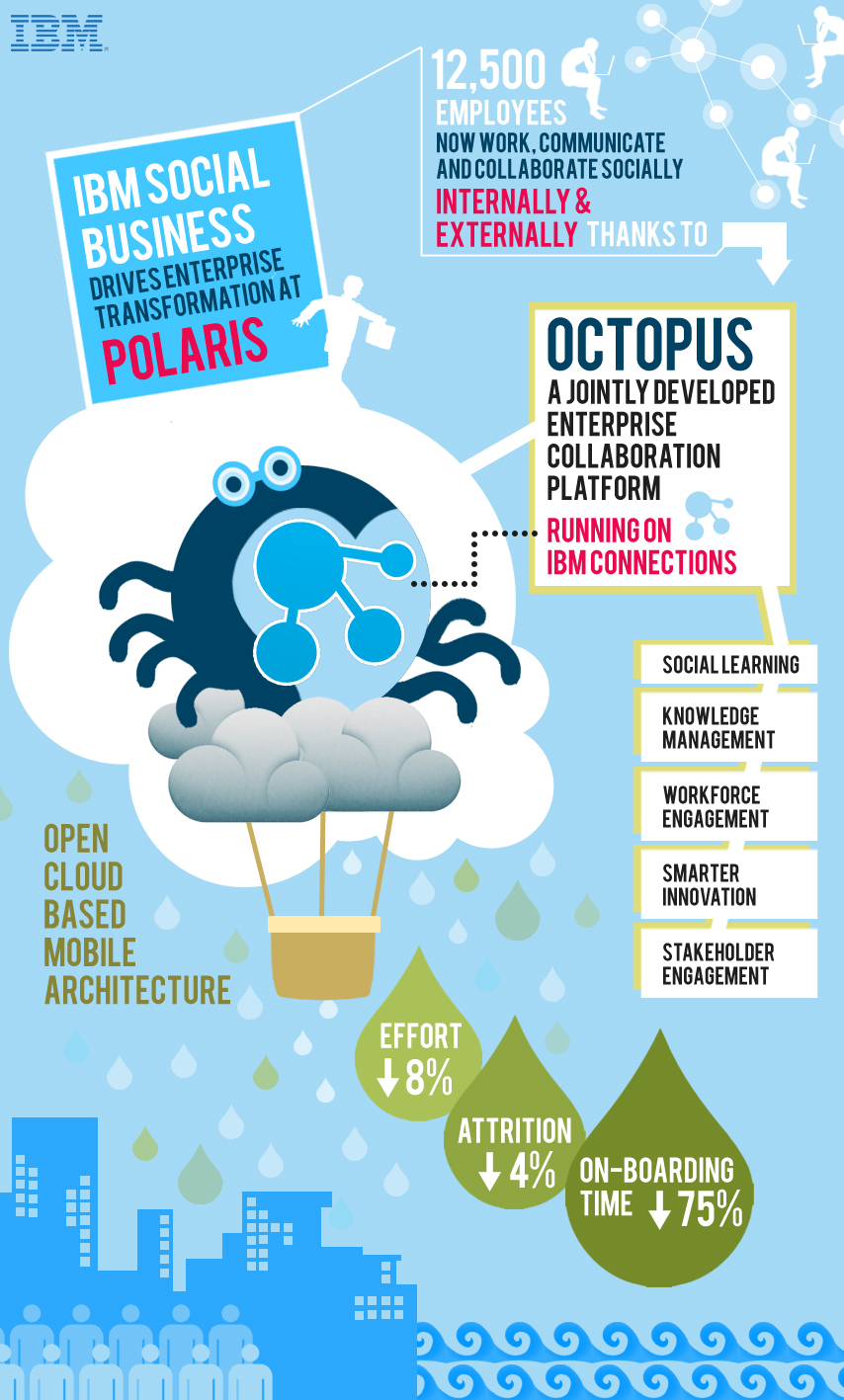
IBM yesterday announced that Polaris Financial Technology has selected IBM Connections to provide employees with a top notch digital experience to improve workforce productivity and accelerate business growth.

By adopting IBM’s leading enterprise social collaboration platform, Polaris FT is transforming how its 12,500 employees connect, communicate and collaborate to drive greater workforce productivity. Instead of relying solely on email to drive essential business tasks and project coordination, the new platform allows Polaris FT to leverage the collective knowledge of every employee to fuel new innovation, ideation and future business growth. This includes a significant reduction in the time it takes to on-board employees new to the company.                                                                                                      


So how did they do this? Working with IBM, Polaris designed and developed Octopus, an enterprise social platform that runs on IBM Connections and uses APIs provided in the IBM Social Business Toolkit. This application makes it easy for IBM partners and clients like Polaris to build an entirely new class of cloud-based social business applications for their businesses using the Connections foundation. With Octopus, Polaris is able to apply social networking, social learning, digital experiences and knowledge/content management tools based on an open cloud-based, mobile architecture.

If you are a developer and want to learn more about how to get started with the SDK, then add this to your agenda:
What: How to Add Social Features to Existing Applications with the IBM Social Business Toolkit
Date:  Apr 28, 2014
Time: 10:00 AM - 10:30 AM (Eastern Time)
This session will show you how to explore the Social API’s that are provided by IBM Connections. You will see the API’s running live in the Cloud. You will also learn about the building blocks that can be reused to add social features to your own applications. Finally you will see a demonstration of how an existing application has been extended to include social features.

To register for the developer webcast, click here.

And that's not all! IBM Connections Next is just around the corner so don't forget to register for the webcast on May 21 to learn more about what's coming in IBM Connections Next.

Thursday, July 21, 2011

Social Software Implications in Regulated Industries

View Comments

A lot of companies are going through the process now to become a social business. While some of the companies that I have talked to have security and compliance as one of their top of mind issues, it still doesn't feel like the majority of companies are thinking about this.

Many have captured the benefits of social media in the enterprise. In my opinion, the benefits are undeniable and I feel that a lot of companies are going to deploy some sort of social media solution in their enterprise if they haven't yet. In fact, IDC reports that social software in the enterprise had a 32% growth in 2010.

Risks in Social Media

As with any collaboration too, regulated companies also see social media as a risk. For example, organizations in financial services, energy, healthcare, or government are subject to regulations such as FINRA, SOX, FERC, NERC, HIPAA, and FRCP to name a few. These regulations are defined by government and industry regulatory agencies and apply to communications via email, instant messaging and now social collaboration.

In Financial Services, for example, you want to prevent insider trading and avoid someone using microblogs or status updates where a broker may say "special rates, guarantee a 200% increase". In Healthcare, patient confidentiality is extremely important and it wouldn't be good if someone wrote in a wiki "Joe Smith is being treated for early coronary artery disease". I think you get the idea.

Managing Risks in Social Media

So what's a company to do? Certainly, not using social collaboration is not an option. Social software vendors are starting to offer solutions to help companies feel comfortable about social media. For example, as WebProNews reports, IBM recently announced their partnership with Actiance to provide a complete governance and eDiscovery solution for IBM Connections.

And building on that, IBM today announced new cloud-based collaboration services to help U.S. Federal government organizations reap the benefits of social computing. The new set of social collaboration services, delivered on IBM’s Federal Information Security Management Act (FISMA)-compliant Federal Community Cloud, addresses the administration's drive to adopt a "cloud-first" policy which is designed to help the government improve its overall IT efficiency and delivery of services to citizens. IBM's Federal Community Cloud is specifically designed to help federal government organizations respond to technology requirements more quickly. The secure, private cloud environment is part of IBM's established and dedicated Federal Data Center that provides secure and comprehensive certified computing capabilities to federal government clients.

From the press release:

“The rise in Big Data and the demand for transparency and collaboration will continue to put pressure on agencies to embrace new computing environments such as cloud to improve IT capabilities,” said Todd S. Ramsey, General Manager, IBM U.S. Federal. “IBM cloud collaboration solutions will help agencies gain faster access to the latest technologies, increase innovation across departments and ultimately improve citizen services.”

Get Social, But Don't Forget About Compliance

WebProNews recently interviewed my colleague René Schimmer to talk about these issues and I've included the video interview here:

Actiance has also created a really good presentation that I wanted to share with you along this topic: 10 Must Have Tips for Security, Productivity and Compliance of Social Collaboration

Social collaboration 10 must have tips for security, productivity and compliance
View more webinars from Unified Communications Online
So get on the social media bandwagon... but don't forget about compliance!!

Article first published as Implications of Social Media in Regulated Industries on Technorati.

Tuesday, August 14, 2012

Exciting Times Ahead: The Case for How Social Media Can Boost Employee Productivity

View Comments

With the upcoming launch of IBM's newest Connections release, I can't help but get excited as to what's about to happen. And of course, when I see the product that I work on as the Cover Story of the USA Today, that gets me even more excited! As you probably saw in Ed Brill's blog yesterday, the USA Today ran a piece on how companies are seeing employee productivity increase with the use of social collaboration tools, such as IBM Connections. The article highlights Newly Weds Foods which uses IBM Connnections for its 2,700 employees to help them share sauces, batters, breadings, and more. To see a video of Newly Weds Foods testimonial, check this out. Also, check out the picture I took of the paper's cover story:

So the next question is, how big is the opportunity for social collaboration tools ? Well, another interesting piece that I ran into yesterday was the 2012 Digital Workplace Trends Report. In it, only 8% of enterprises surveyed claim to have a social business platform rolled out enterprise wide. The number at first seemed very small to me, but when you compare that with 33% of organizations that say they have sporadic deployments, it makes sense. However, it concerns me that companies are still taking a silo'ed approach instead of taking an approach where silos are destroyed.

What's very encouraging, and validates IDC prediction that spending will continue to increase in this area, is that the report found that 47% of organizations are planning to increase their investment in social collaboration tools.

Exciting times ahead!

Friday, February 18, 2011

New Whitepaper: Becoming a Social Business

View Comments
IDC has just released a new whitepaper called "Becoming a Social Business". The timing for this whitepaper couldn't be better as we are all getting settled from an amazing week at Lotusphere #ls11 where the theme was Social Business. IDC believes social networking applications are now becoming a huge business opportunity. At the same time, it notes that some places still fear social networking applications because they may lead to wasted time.

In the whitepaper, IDC quotes a study it made titled Social Business Survey where 41% of respondents said they were using social software. 35% of respondents believe that social software has increased productivity in the workplace! If I'm doing my math correctly, 85% of those using social software have seen an increase in productivity, with some noting up to 30% in time savings. I think the tide is turning and 2011 is going to be a tipping point where more organizations are going to rely on social collaboration tools to become more agile and beat their competitors.

To further prove that social collaboration is valuable, IDC partnered with IBM and conducted various interviews with different divisions of IBM to understand how they were using social software to accelerate innovation, provide deeper customer/employee relationships, and achieve quicker decision-making capabilities. I was one of the interviewees along with Luis Suarez and Rawn Shah.

For each interview, IDC compiled a list of "challenges", "tipping points" and "results / ROI". In other words, it lists what challenges existed, what caused a particular individual or department to embrace social business, and what have been the benefits/value obtained since becoming a social business. Towards the end of the whitepaper, IDC captures some best practices that may help kick start adoption of social software inside of your enterprise.

If you are thinking about becoming a social business, but have doubts as to its value, this whitepaper is for you. To download the free whitepaper, go here.

The whitepaper is 12 pages long and available in PDF so it's easy to store in your iPad (or favorite eReader) to read on the go. What do you think of the whitepaper? Is it something you are going to distribute to your customers?

Tuesday, September 4, 2012

The Value of the Social Media Economy is $1.3 Trillion

View Comments

The McKinsey Global Institute recently released a report titled: The social economy: Unlocking value and productivity through social technologies. I stumbled upon this report on Friday and spent some time at nights reading it over the weekend.

What's impressive is how McKinsey has been able to quantify the value of what social technologies can add into the economy. The total? A massive $1.3 Trillion ! Yes, Trillion! 70% of organizations are already using social technologies and 90% of those report some benefit. And most companies see a 20-25% increase in knowledge worker productivity. I for one have shared how social tools make me productive. This report also reminded me how IBM and MIT scientifically proved the value of social networks at work.

In the McKinsey report, a familiar use case, among many others, was included: TD Bank who leverages IBM Connections as its social business platform. (coincidentally, IBM Connections 4.0 was announced today)

One of the things I liked about the report is that it includes a lot of examples from companies in a wide variety of industries: Financial Services, Consumer Packaged Goods, Professional Services, Manufacturing, and more. Therefore, irrespective of the industry you work on, you are likely to find a success example in the report.

Over the weekend, I also stumbled upon this quick video that (while an ad for another company) has some nice visuals to explain the power of social media for your business

Are you still considering becoming a social business? Or do you want to learn tips on how to become a social business ? Want to learn how other companies are getting value from becoming a social business? If so, then you *must* attend the following webcast next week:

Register today!!

To download the 184-page McKinsey report (for free) or even get a free eBook copy for your iPad, go here. I also recommend that you listen to the 10 minute audiocast embedded on that page with lead researcher Michael Chui.

Thursday, October 21, 2010

IBM Makes Office Productivity Suites Go Social!

View Comments

IBM has just released their latest version of Lotus Symphony, their free award-winning office productivity suite built on top of Eclipse and OpenOffice.

And Symphony even becomes social thanks to the free plugins that are available. First, there's a plugin to generate an organizational chart based on the information coming from the Profiles service.


Additionally, if you are using LotusLive Connections, there's a plugin to allow you to easily open, edit, and publish files to/from LotusLive directly from Lotus Symphony.


If you have SharePoint internally, there's a plugin for that as well! Or even better than SharePoint, if you are using Lotus Quickr, there's a plugin that lets you check-in/check-out, edit documents, upload documents, integrates with your ECM, and even works with your established workflow patterns.


Another plugin you might be interested in is the Wiki editor plugin. This plugin allows you to create documents in Lotus Connections and convert them into a Lotus Connections Wiki or Confluence Wiki. Need an offline wiki editor? This is the plugin for you!

If you are using MediaWiki, there's also a plugin for that.

If you are interested in calculating how much money you would save by dumping Microsoft Office and switching to Lotus Symphony, check out the calculator here. And if that's not enough to convince you, you could still download the social plugins from IBM for Microsoft Office.

You are convinced, right? Then go ahead and download this plug-in to batch convert all your Microsoft Office files into OpenOffice format and start enjoying the power of FREE!

Version 3 of Lotus Symphony is available Windows, Mac, SUSE Linux, RedHat, and Ubuntu and can be downloaded from here.

Wednesday, November 14, 2012

Demo: Increasing Productivity with IBM Notes Social Edition

View Comments
Today, Ed Brill and team announced IBM Notes 9 Social Edition and the upcoming public beta to be released in a few weeks. If you missed it, check out Ed's blog for a link to the replay.

I've been using the internal beta for a few weeks now and really like the integration with IBM Connections, IBM's social collaboration platform.  Based on personal experience, IBM Connections makes everything social and improves the productivity of its users.  And the IBM Notes 9 Social Edition is a prime example of that.

The video below gives you a preview of some of the new integration points of IBM Connections, real-time communications powered by Sametime, and Notes all in one seamlessly integrated user experience.  The video also shows video conferencing both from Notes and from a community in IBM Connections.


I've already gotten some very good feedback on this video and I'm interested to know: What do you think about this video ?

Monday, April 14, 2014

As Seen in the Masters: Social Business is about Productivity, Innovation and Influence

View Comments
Over the weekend, IBM had a run of ads in print media and on TV with many different spots going throughout the Masters.

The spots were around IBM's 4 big areas: Social, Cloud, Mobile, and Big Data.  It was fun to hear from my friends and family who had seen the spots and mentioned how it was really hard to miss the IBM spots.

The spots highlight customers and scenarios that are being Made with IBM.  If you are not a golfer and want to watch the entire series, check out the IBM channel on YouTube.  Additionally, check out the Made with IBM site for more details and customer stories, such as this one on how Princess Cruises is optimizing their operations with social.

Below, I've included 4 videos that are specifically around social business, powered by IBM's enterprise social collaboration platform,  IBM Connections.

#8 - Workforce productivity


#28 - Crowdsourcing Innovation


#45 - Collaboration made with Social


#65 - Influence made with Social


Ready to get started? Start your free trial over at http://ibmcloud.com/social

Friday, July 25, 2014

Announcing the latest IBM Connections Mail Plug-In

View Comments
Today, IBM Connections Mail gets an update. If you don't know what IBM Connections Mail, let's catch you up.  IBM Connections Mail provides a simple and compelling way to perform essential email and calendaring tasks right from IBM Connections.

This is particularly useful as you can process your inbox with minimal context switching.  According to McKinsey, when users switch from one task to another, it really affects productivity.

Therefore, by keeping context switching to a minimum, you increase productivity in your organization.  Additionally, sending attachments is a snap as they are sent as links via IBM Connections (a feature that our competitors have copied).

Of course, with the IBM Connections 5.0 release less than a month ago this new version of IBM Connections Mail now fully supports IBM Connections 5.0.  Here's the other new capabilities:
  • Accept/Decline calendar invites
  • Save messages as draft
  • Adds support for Domino encrypted mail
  • Adds direct access to the Microsoft Outlook Web App
  • Adds support for Microsoft Exchange 2013
Here's a screenshot of the save as draft and accept/decline screens:


Here's a demo that was recorded when this originally shipped. 


Go get it from our catalog using this direct link!


Tuesday, December 2, 2008

According to the News: Social Software Increases Productivity

View Comments

I've been quiet. I know. There are several reasons for that:

  • I'm working on a BizTech project and I can't say much more than that. For now, just know that I'm coding something that will soon be offered by IBM as part of our social software offerings! Oh and if you are following my Tweets, then you know that I'm using Dojo for that
  • Lotusphere is around the corner (46 days) and can't spill the beans on the surprises to come (yet)
  • Working on several opportunities that we are trying to close (including several million users!!! wow!!)
  • Running the World Wide Social Software Community. As the leader for the IBM Social Software Community (1000+ members) I've been busy lately planning out the schedules for our upcoming speakers, putting together the newsletters, and planning the events for Lotusphere. Running a community is a lot of work! I may have to blog more about this later...
  • Learning a bit about .NET development for a project I have in Toronto next week

But trust me. I've not forgotten about you! I still have a couple of blog posts queued up that I have to review and post. In the meantime, I wanted to share the following piece of GREAT news (pun intended). My good buddy, Adrian Spender just blogged about this. RTE News, based out of Dublin, yesterday visited the IBM Dublin office where about 50% of IBM's social software development team is located.

After interviewing several IBMers, including my good old friend Mike Roche, RTE News put together the following news clip on yesterday's nightly news. Here you will learn a little bit more about IBM's Beehive, a proving grounds for social software where the most interesting and useful features would then make it into Lotus Connections.


In the video, the reporter emphasizes how IBM is using social software to make their employees more productive. This is great timing, given IBM's CEO Sam Palmisano's recent comments that:

IBMers are figuring out how best to incorporate social networking into their work, at a pretty good pace. They're figuring out that collaboration isn't a productivity hit, it makes them smarter.

Enjoy!

Wednesday, May 27, 2009

Free Puerto Rico Leadership Forum

View Comments

In two weeks, I'm going to be presenting at the Caribe Hilton in Puerto Rico at IBM's Free City Tour of Building a Smarter Planet. The event takes place on June 9th and is open to the public. Here are the details for the event:
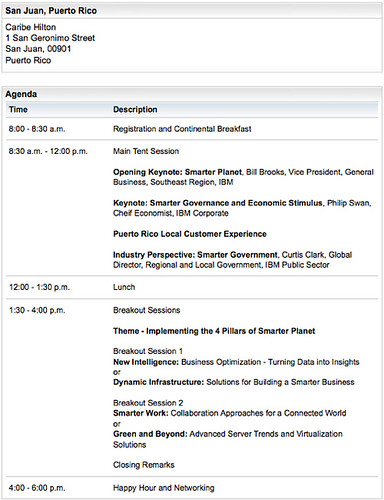


My session is called "Smarter Work: Collaboration Approaches for a Connected World". I'll be talking about how to embed collaboration and social software into existing processes to improve efficiency, and reduce costs from by improving productivity in the workplace.

If you want to register for this FREE event, sign up here before June 1st. See you there!

Monday, September 28, 2015

The Heart of Business Tour Comes to Boston Next Week

View Comments

The Heart of Business is about … YOU! Join business leaders, IBM business partners, innovators, and thought leaders to connect and win. Learn how to use Social Business Solutions to accelerate innovation, improve collaboration, manage relationships, and deliver better metrics.

Enterprise social networks are becoming the heart of business productivity and engagement. Successful businesses today are using their enterprise software platforms to create an ecosystem of capabilities, which drive influential innovation, dynamic relationships, connected collaboration and integral outcomes.

Join us to learn, share, and socialize with IBM and our business partners, including HYPE, Kaltura, Hootsuite, panagenda, Riva CRM and TrustSphere. Creating valuable outcomes for your business. There will be a panel of Business Leaders and distinguished guests who will engage with the audience on ideas and success factors that can help one's business increase value in the new age of social technology and customer experience.

Next week, the #HeartofBusiness tour comes to Boston and I'm going to join the amazing list of speakers there. From there, it heads out to San Francisco and New York. Check out this video which describes what the event is all about:


If you are nearby, check out the agenda and register now.

See you there! 

Thursday, August 4, 2011

Why Should I Care About Social Media Behind the Firewall

View Comments

Last week, I delivered a webinar that was hosted by InfoBOOM. In the webinar, I talk about some of the reasons why social media behind the firewall is beneficial to companies of all sizes. As an example, I reference the value that I personally get by using social media inside the firewall.

Here's the description that we used for the webinar invite.

Social media isn't limited to external communications. It can be a powerful force for productivity improvement and morale building inside the firewall.

The payoff: People are talking, and when that happens sources of expertise emerge from unexpected places. Social networks enable people to discover information, get questions answered and find new partners in collaboration. These tools are achieving the goals that early knowledge management systems set out to accomplish more than 20 years ago. The difference is that employees willingly contribute their expertise and enable the organization to capture their knowledge when it's in the cause of helping other people solve problems and get work done.

If you couldn't join the webinar and are interested in the business value of social media behind the firewall, you can watch the replay here. You'll notice that during the webinar a storm came in and knocked out power to my apartment so that provides for some laughs and entertainment as we try to adjust midway through.

Aside from business value, I also cover an important topic: the challenge of adoption. Once you deploy the technology, how do you actually get people to use it? I share some tips based on some lessons learned.

Hope you enjoy it!

Thursday, April 24, 2014

Enterprise Social Software Market Hits $1B, IBM Leads for 5th Consecutive Year

View Comments
Hot off the press!

IBM today announced that for the fifth consecutive year, IDC ranked the company number one in worldwide market share for enterprise social software.

According to the press release, IDC's analysis of 2013 revenue, the worldwide market for enterprise social software applications grew from $968 million in 2012 to $1,242 million in 2013.

The press release quotes IDC's Vanessa Thompson:
Customers are increasingly assuming that all applications must be social.  IBM's focus on a core social networking platform to support application environments, such as Smarter Commerce and Smarter Workforce aligns well with this customer intent.
Here's a look at the key innovations in the past 5 years (click to see it full screen):

Achievements over the past 5 years for IBM Connections


The news comes in timely as we are getting ready to unveil IBM Connections Next on May 21st.  If you haven't yet, register for our virtual event Collaborate or be Left Behind: Leading the Digital Frontier.

IBM's Social Business portfolio, including its industry leading IBM Connections and Smarter Workforce technologies, allow organizations to integrate social solutions with critical business applications and people-centric processes that empower employees, increase workforce productivity and deliver exceptional customer service. Deployed on cloud or on premises, these solutions also enable business leaders like the Chief HR Officer (CHRO) to attract and retain top talent when combined with social workforce analytics that ensure the organization has the skills and expertise to meet emerging market demands.


The press release also quotes our General Manager, Craig Hayman:

The transparent nature of today's business environment, combined with the integration of social, cloud and analytic capabilities into everyday processes, has fueled the emergence of a Smarter Workforce.  We’re thrilled to be recognized by IDC as the market share leader for the fifth consecutive year as our clients continue to harness Social Business to accelerate innovation, increase agility and remove boundaries to collaboration.

Want to see what's coming in the latest release of IBM Connections? Then don't wait and register today and see you on May 21st.

Tuesday, October 25, 2016

IBM Announces a New Category: IBM Watson Work

View Comments
In today's press release, IBM announced a new category called IBM Watson Work. In that category there are two new offerings that will be available: IBM Watson Work Services and IBM Watson Workspace. IBM Watson Workspace uses cognitive analytics to help users communicate with their teams and focus on key business outcomes. Teams now have a single space to manage all their work conversations and avoid information overload with smart summaries that highlight the most relevant actions and decisions so team members stay aligned and prioritize daily tasks quicker. This is what you may heard before as Project Toscana.

IBM Watson Workspace is built on a platform that we call IBM Watson Work Services. Watson Work Services provides a set of APIs built to help developers build apps that understand conversations and interpret user needs and intent using natural methods of communication. Developers can use these to infuse Watson Work capabilities into existing work applications and products or accelerate differentiation when building new apps.

Here's an excerpt from the press release:
Businesses today need to apply cognitive-powered productivity applications and services to digital content, conversations, and workflows to empower their employees with the ability to find, connect and work with the right experts; speed access to relevant content and insights; and provide the time and space to work simply and together.
  • IBM Watson Workspace learns how an individual works and interacts, and consolidates multiple work conversations from various communications channels into a single space. Using Watson, the technology is able highlight the most urgent action items, point to the right content needed at the time, and automate everyday tasks so employees can focus on key business outcomes. 
  • IBM Watson Work Services are a set of cognitive APIs –Action Identification, Moment Identification, and Summarization – given to developers through the offering’s website so they can infuse cognitive capabilities into existing work products and applications such as IBM Watson Workspace, third party applications, and when building new applications. The technology uses natural language classifiers that are pre-trained to identify key ‘actions, questions, decisions, and commitments in a conversation. It can analyze and disambiguate context to facilitate fulfillment of the next action. For example, if someone says: "Great point –let's schedule a meeting to discuss further," the system can identify 'schedule a meeting' as an action, and help the person find the best time to continue the conversation.

One of the cognitive capabilities available today in the preview is called "Moments". You know how painful it is to catch up when you've been away from work on vacation, out for a meeting or just lunch. You come back to a mess of information, and the time you spend catching up, is time that you are falling behind. No more! With Moments, Watson gives you summaries of conversations (think of it like Cliff Notes!) and at a glance you can see what was talked about, who was engaged, the content that was shared, etc. In seconds, you are caught up and aligned with your team.


Today, Inhi Cho, GM for IBM Collaboration Solutions, takes the stage at 4pm PT to share more about this announcement and it will be live streamed! And I get the opportunity to walk the audience through the flow. If you want to watch the live stream today, head out at 4PM PT to: https://ibmgo.com/wow16/session/NhtQjL5BRJGM4FJqC


IBM Watson Workspace (aka WW aka "dubdub" as the cool kids would say) is currently invite-only.  All IBM World of Watson attendees have access to IBM Watson Workspace. They can just log in with their IBM ID/password that they used to register for the conference. Those attendees can invite as many people as they wish, and those in turn can also invite others. So if you don't have an invite yet, find someone that attended the conference so they can hook you up.