Pages

Showing posts with label atlas. Show all posts

Thursday, January 6, 2011

Social Business ROI - Why Do You Need This With Examples Like This?

View Comments

I can't think of a better way to start the year 2011 than with an amazing success story that led to increased customer satisfaction thanks to social collaboration. My colleague Fred Raguillat wrote this up, so I'll let you read through his awesome story:


This is another scenario where IBM's Social Collaboration Platform & Atlas made finding experts & collaboration across continents an easy task..!

Adam Ramsay and Rob Thatcher from IBM UK needed Dev Technical assistance fixing a deployment problem with Mobile for their customer. Using IBM social software, we were able to successfully resolve the problem within 24 hours across two different continents.

Here's the sequence of events...

16:45, Monday December 6th GMT, Adam Sametimed with me, asking for help with his problem.  Michael Roche (Lotus Connections Distinguished Engineer) had referred Adam to me for assistance on "mobile application issues with applications".

By 17:12 I had all the information I needed from Adam and Sametimed Luis Benitez for help identifying developer(s) in in the U.S. that could assist. Luis performed a quick tag search using Lotus Connections ('mobile', 'development', 'connections'), identifying the best two qualified developers. With three clicks he narrowed down a company of 400,000 employees to 2 employees!

image

I then used Atlas to find my "contact entry point" (my link to those guys). I then mailed a "help request" to all the relevant parties..


At 18:30 Jesse Hill, one of the mobile LC developers, confirmed that he would be happy to help..

At 8:00 the next morning the UK team sent the log files over to Jesse in the U.S. By that afternoon Jesse sent a fix on to Rob. Rob made the relevant changes, and by 17:00 Rob sent an email to confirm that all issues were resolved.

Sounds easy, yes!? but think if we did not have those tools in our reach, this would have taken for ever..!

Thanks to IBM Social Software, we’ve got another happy customer! ;-)

-=-=-=-=-=-=-=-=

From: Robert Thatcher/UK/IBM@IBMGB
To: Adam Ramsay/UK/IBM@IBMGB
Cc: Tony Hickman/UK/IBM@IBMGB, Jesse Hill/Phoenix/IBM@IBMUS, Fred Raguillat/Ireland/IBM@IBMIE
Date: 07/12/2010 17:13
Subject: Re: Fw: Help Request! RBS Lotus Connections mobile assistance


Adam,

Headline is good news Mobile is fixed and working.

Longer story is that Jesse found the problem very quickly, and it is fixed in 2.5.0.2. But rather than disturb the system Jesse gave me a work around to the Configuration file. I have made the change to the config file, and restarted the Mobile app only. I would suggest a complete restart of WAS when convenient to confirm that the config changes did not upset other functions.

THANKS Jesse.

Rob


How's that for a success story? And it would've been less than 24 hours if it wasn't for the timezone difference.

Thursday, September 30, 2010

My Take on Building the Enterprise Social Graph

View Comments

On Monday, Forbes published an article called Building the Enterprise Social Graph with the subtitle In the next decade, we will learn how to build a social graph inside our businesses. What will it mean?

The subtitle surprised because it talks about the next decade. Sure, there are still a lot of enterprises that haven't adopted Enterprise 2.0 methodologies to transform their business, but are we really a decade away? Maybe I'm spoiled because we've had our internal social graph available for years now as part of Atlas. But I thought I'd also seen some stats that claim a lot of Fortune 100 companies have deployed some sort of social software behind the firewall (but couldn't find them).

Anyway, I do like how the author, however, points out how quickly starts stating that:

The internal social graph inside companies will be quite different and far more useful than existing public counterparts

And this resonates very well with me. Out of my typical 8 hour day, I spent probably 6.5 hours using our social platform inside our firewall. That's where I search for people and content. That's where I discover new experts to follow. That's where I collaborate with other colleagues all over the world. I barely spend any time on my personal social network within Facebook.

The Forbes article also presents an interview with IBM's VP of Social Software, Jeff Schick. Here's a demo of IBM's enterprise social graph tool which mines data to map relationships:

To read the full article, click here. Would love to hear your thoughts.

Tuesday, May 5, 2009

Merging Social Networks: Not a Hard Task Anymore!

View Comments

Last week, I developed a Java tool to merge the social networks from internal research projects (e.g. BlueTwit, Beehive, and Fringe) into Lotus Connections using the Colleagues RESTful API. Credit goes mostly to Ansgar Schmidt for the idea and for the Fringe/BlueTwit code!.

Based on initial feedback, users love it and they are saving a LOT of time. What used to take hours, now only takes minutes. As a side benefit, it has helped people discover the new Lotus Connections v2.5. So tons of benefits all around!

One concern is the amount of email this tool generates. For each person you invite in Lotus Connections, an email is sent out to the invitee. That's good because if they weren't aware of the company's Enterprise 2.0 efforts, now they would be. Now based on the viral adoption that I saw inside IBM (over 100 downloads in the first 4.5 hrs) for this tool, this tool also has the potential to generate a lot of emails.

Anyway, this has caused a debate within IBM. How should invites work in a social network? And, specifically to Lotus Connections, do others really have to accept your invitation before you can add them to "your network" ? How should this work in internal social networks? I was talking to a colleague earlier today about this and we agreed that there are two types of networks:

  1. Your colleagues - People I Know and work with them on a frequent basis
  2. Following - People I Follow because I want to stay up to date on their activities and learn from them.

The first group could should be automatically determined by Atlas. Atlas always knows and keeps track of who you are actively working with. There shouldn't be any formal process to make someone your colleague. They just are and the system knows it.

The second group is asymmetric follow (a la Twitter). In this model I can follow someone but they don't have to approve my request (unless they have disabled public access of their timeline). In this case, I can add someone to my network and an email invite wouldn't have to be sent (unless configured by an admin or end-user in Connections).

Anyway, if you have any thoughts on how to improve the invite model for social networks, let me know. I also asked the question in Twitter so I'll be consolidating responses as we go along.

Also, question to non-IBMers. Would you like to use this tool to merge your own social networks into Lotus Connections? For example, bring in your LinkedIn, Facebook, Twitter networks into Lotus Connections ? Would love to hear some feedback on this.

photo credit: psd

Thursday, March 5, 2009

Atlas for Lotus Connections Demo

View Comments

A lot of you have been asking for a demo of Atlas for Lotus Connections that you can use to show your customers (or even to show to your executives). Well, I just noticed that one has been finally posted on the IBM.com site!

I've tried to embed it here, but I wasn't able to resize it. Therefore, if you can't see it well here, please get the full-screen version of the demo here.

If you are not familiar with Atlas. Here's a quick summary:

The different components of Atlas allow users to:

  • Visualize and analyze social networks in an organization.
  • Identify the shortest path to reach someone.
  • Find expertise across extended networks.
  • Visualize and manage their personal networks.

Enjoy!

Thursday, February 19, 2009

Atlas for the Mac Is Here

View Comments

Who says blogging is a waste of time ? What a great example right here. You may remember that on Monday I blogged about my first Lotus Notes 8.5 application for the Mac. Now, I originally started this project last summer! That's right over 6 months ago. When I hit the roadblock that I documented on Monday, I quickly started to search the web. Nothing turned up an answer. Since Notes 8.5 was still in beta at that time, I decided to abandon the effort.

When Notes 8.5 shipped earlier in the year, I thought it would be a good idea to pick up the project again. I knew that if I hit a roadblock, I could get official support. Well, as I said earlier this week, I was stuck because I couldn't call the Notes API from my SWT Java program. At that point, I blogged about my status, and quickly summarized what I had done up until that point. I also noted that I had opened an IBM Support ticket and was waiting for assistance.

200902192136.jpgAnd then magic happened! 1 hour and 22 minutes after I posted the blog, the answer came to me!!! Karsten Lehmann, one of the developers for MindPlan, kindly posted a comment detailing that he had gone through the same issue. He suggested a couple of things, I responded back and voilá!
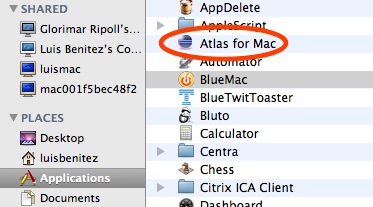
Here's how I configured Eclipse to run my SWT Java application for Notes in my Mac OSX Leopard:

  • Under Arguments, added the following VM Argument: -Djava.library.path=/Applications/Notes.app/Contents/MacOS
  • Under JRE I selected Java 1.5.0 (for some reason it wouldn't work with Java 1.6)
  • Under Environment I added 3 environment variables:
    • PATH -> /Applications/Notes.app/Contents/MacOS
    • LD_LIBRARY_PATH -> /Applications/Notes.app/Contents/MacOS
    • DYLD_LIBRARY_PATH -> /Applications/Notes.app/Contents/MacOS

At this point I could get my application running beautifully under Eclipse, but I couldn't run it as a stand-alone application. Time to do some more searching!! After a couple of days, I finally figured it out. First, Eclipse includes a really cool feature that lets you export your Java applications as Mac Bundles.

Next, because of the way Mac works, I had to set the DYLD_LIBRARY_PATH environment variable first, before running my application. Therefore, I had to create the file ~/.profile with the following line:

export DYLD_LIBRARY_PATH=/Applications/Notes.app/Contents/MacOS

And now, IBMers can use Atlas from their Mac computers!

Monday, February 16, 2009

Developing Java Applications for Lotus Notes on the Mac

View Comments

This week I've been working on creating my first Java application for Lotus Notes v8.5 on the Mac. Now you may be asking how this can be my first Java application for Notes on the Mac since I already hacked Lotus Notes to include the Activities sidebar. While that is a Java application, it's not one that I created and second it's really an Eclipse plugin that runs inside of Notes. What I'm trying to do is create a Java application that runs outside of Notes, yet queries Notes for information.

So what am I doing? Well, as a side project, I decided to port the code for Atlas to the Mac. The Atlas client is just a Java SWT application, so how hard could it be?

Deploying SWT applications in the Mac

The first step was to figure out how to actually get an SWT application running on the Mac. The folks at Eclipse have already documented this process and it's pretty straightforward. The key is to put in the SWT libraries for the applicable platform. Therefore, I removed the swt.jar and related DLLs from the Java application and put in the Mac OS X SWT.jar and libraries.


200902132207.jpg

Troubleshooting SWT applications in the Mac

Double-clicking the application, didn't do anything. Time to troubleshoot! I downloaded and installed Eclipse 3.4. Running the application from within the Eclipse environment shed some light on the problem: for some reason the Notes libraries could not be loaded by the Java Virtual Machine (JVM). I posted a question about my problem in the Lotus Notes 8.5 forum and hope someone can provide an answer. Additionally, I've opened a PMR to get official help from IBM.

How It Looks

To prove that it was just a Notes issue, I commented out all the code calling the Notes APIs. I recompiled, ran it and saw the following.


200902132221.jpg

So I'm almost there... as soon as I can figure out why I can't call the Notes APIs from my standalone Java application, I should be golden! Isn't Java great ?

Tuesday, August 5, 2008

A PoC that went downhill

View Comments
Last week, I received the sad news that the social software PoC (Proof-of-Concept) at a customer in the West coast has failed. For all vendors involved!!
I have to say that I'm pretty disappointed, but not surprised. Tried as we might, the customer didn't want to follow our recommended practices. Reasons for the PoC to fail became clearer as I read the explanation from the customer. Let me give you some background first.
Now, I wasn't heavily involved in the PoC, but assisted on an as-needed basis. My teammates on site kept me on the loop as needed. The PoC was led by the organization's IT department. There was a sponsor from the business side, but it seemed, in my opinion, that their feedback was not considered at any time.
There were 4 vendors participating in the pilot and all systems were deployed as-is and "thrown" at over 200 users. The users were given no instruction on how to use the system. They were simply given a URL and a survey with over 20 questions: "Did you like this? Did you like that?, etc". Is there any surprise all vendors failed in this scenario? Not at all.
Looking at the 10 Principles for Social Software Adoption, I don't see that this company followed them. One of the users' complaints was that the system didn't provide valuable information. I don't think that's a surprise given the system wasn't properly populated with data. Think about it... if you go to a social site and it's empty.. Would you like it? I remember when I first joined Facebook I was loner and didn't really use it since my friends were not there. For the longest time, I only had 10-20 friends . Even my wife, who's a graduate from MIT didn't find it cool for a while! But as more people joined, I was hooked!
Additionally, the customer was considering and making the 4 vendors compete in their best of breed areas.. i.e. profiles vs blogs vs communities vs social bookmarking etc. They even tried integrating all of them to provide a "better" user experience, but the user experience was the biggest complaint from end-users.
So let me throw out some recommended practices for a social software PoC (Mike Stopforth blogged about this earlier too):
  1. Identify business goals - In order to measure the success of a PoC, there needs to be a goal to be met. Define it (e.g. improve communication with blogs)
  2. Choose your audience - Needs to be people who need to share knowledge (e.g. R&D, development, etc)
  3. Choose your evangelizers - These will be your salesmen. They already exist in your enterprise. Who do people go to most often for answers? That's who you need. Or you can use Atlas for Lotus Connections to find out. Have them start populating the system.
  4. Conduct a pre-assessment - Ask your audience how they accomplish, today, their day to day tasks such as finding people, finding collateral, keeping up with topics, etc.
  5. Get input from evangelizers - Based on the enterprise's culture what should be deployed first? How should it be deployed?
  6. Train your evangelizers - so they can train others...
  7. Conduct a post assesment - After a reasonable length of time, figure out what worked and what didn't, fix it and keep going.
  8. Integrate with other tools - Is your enterprise mobile? Deploy the BlackBerry plugin. Do they mostly live in a portal? Deploy the Connections portlet. Make sure that employees can access Lotus Connections from where they work! Hey, it's all free, so you might as well!!
And there you have it. If you follow those tips and hints, you'll be on your way to a successful PoC. Need more ? Contact me and I'll be glad to help your organization through it.
How about you? Have you had any successes / failures deploying social software? Any that you want to share with us?

Thursday, July 24, 2008

How to add Atlas 'Reach Me' link to Lotus Connections Person Card

View Comments

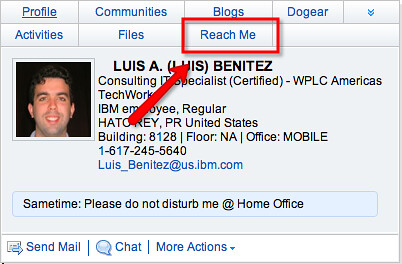
2008-07-24_1012This is a "repost" (is that the right term) of How to add a Microsoft Sharepoint MySites link to the Lotus Connections Person card, but for Atlas for Lotus Connections. Once you follow these instructions, you are going to integrate Atlas for Lotus Connections with whatever application renders the Peson Card: Lotus Connections, Confluence, SocialText, Quickr, Microsoft Sharepoint, SAP Portal, WebSphere Portal, and the list goes on and on.

Here's what you need to do: 1. Figure out the URL to a person's 'Reach Me' (usually something like: http://atlas.tap.ibm.com/reach.do?reachUser=luis_benitez@us.ibm.com) 2. Save a backup copy of: WAS_HOME>\profiles\<WAS_Profile>\config\cells\<Host_name>\LotusConnections-config \LotusConnections-config.xml 3. Open the file from #2 with your favorite text editor 4. Add the following line (it's 1 line, but it wraps):

<sloc:serviceReference serviceName="atlas" href="http://atlas.tap.watson.ibm.com" enabled="true" ssl_href="http://atlas.tap.ibm.com" ssl_enabled="false" person_card_service_url_pattern="/reach.do?reachUser={email}" person_card_service_name_js_eval="'Reach Me'"/>
5. Save and close the file 6. Save a backup copy of: WAS_HOME>\profiles\<WAS_Profile>\config\cells\<Host_name>\LotusConnections-config \service-location.xsd 7. Open the file from #6 with your favorite text editor 8. Add the following line (under <xsd:simpleType name="serviceNames"> --> <xsd:restriction base="xsd:string"> )
<xsd:enumeration value="atlas" />
9. Save and close the file 10. Restart Profiles That's it!! See, I told you!! All it took was TWO LINES OF XML!!! No coding!

Wednesday, June 4, 2008

Collecting usage metrics in Lotus Connections

View Comments

Lotus Connections v2 (which will be released in less than 2 weeks) adds some very nice capabilities to visualize usage metrics. These metrics are useful during a Pilot and/or Production phase of deployment.

During a pilot, it's important to see how much the servers are being used so that we can use that information when estimating a deployment architecture for production. It's also valuable to see how adoption is progressing. I, however, wouldn't rely strictly on usage reports to gauge the adoption within an enterprise. Instead, I think that's a task that the Atlas component for Lotus Connections can do much better!!

During production, it also helps to see how the system is utilized to help gauge whether it needs more capacity. Don't, however, rely strictly on these reports. You should definitely use better server reporting tools.

Anyway, I figured I would share with you some of the reporting capabilities that will be available in less than 2 weeks! Here's a preview of what you can expect:

Activities:

200806042105.jpg

Blogs: (updated 06/05/08 to add missing Blog screenshot)

200806051652.jpg

Communities:

200806042106.jpg

Dogear:

200806042106.jpg

Homepage:

200806042107.jpg

Profiles:

200806042107.jpg