Pages

Showing posts with label open-source. Show all posts

Thursday, September 13, 2012

IBM Fully Behind OpenSocial and ActivityStrea.ms

View Comments
When OpenSocial 2.0 was shipped late last year it was declared ready for the enterprise and that's no surprise since a big push towards OpenSocial 2.0 was driven by companies such as IBM.

In the latest release of IBM's social collaboration platform, IBM Connections 4.0, IBM has included support for OpenSocial 2.0, OAuth2, and ActivityStrea.ms. The latest release also features something called "Embedded Experiences" which was a concept invented by IBM and donated to the open source community. IBM is also currently the lead editor of the ActivityStrea.ms standard and is the top code contributor to Apache Shindig, an open source reference implementation of an OpenSocial container.

With IBM and other social collaboration vendors adopting OpenSocial it presents a prime opportunity for developers who want to build apps on top of these platforms. They build once and they can use anywhere!


Earlier this year, Dion Hinchcliffe blogged about the need for Enterprise Social Networks to leverage Open Standards. He not only outlines the benefits of open standards for developers, but also to the enterprise. Specifically, Dion says (emphasis mine):
[…] the business value of social media is best achieved when it's centered in the work that we do, not off to the side. This can only be achieved by connecting our systems of engagement (social business tools and platforms) with our systems of record (CRM, ERP, HRM, etc.)
Updated 13/Sept/2012 @ 9:15a - I was alerted that Dion Hinchcliffe joined the OpenSocial board earlier this year.

And you can see IBM fully understands this as part of their launch video for IBM Connections 4.0 shows integration with SAP through an OpenSocial gadget.

ISW, an IBM Business Partner, has created a gamification solution for IBM Connections and it uses the OpenSocial standard meaning that their solution could work in other platforms as well. To see it in action, see the video below (skip to 13:03):


AppFusions is also taking advantage of this integration point and even blogged about this earlier this week.

OpenSocial is definitely now ready for the enterprise! Oh and if you want to learn more about IBM Connections, don't forget to register for today's webcast From liking to Leading: The Success of your Business is Social (click the invite below to register):


Register now!
Thursday, December 18, 2008

How To Allow Anonymous Comments in Lotus Connections Blogs

View Comments

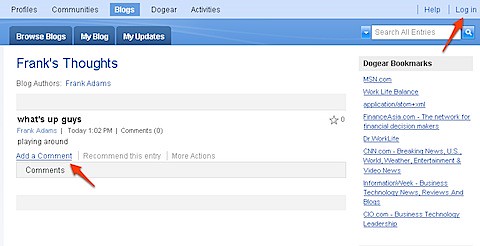
Well, sort of. A customer this week asked me how to modify the blog template so that anonymous users could click on the 'Add a Link' comment. By default, the link is completely disabled until the user clicks on 'Log In', authenticates, and returns back to the blog entry.

I took it upon myself to look at the blog theme and figure out how to make this change. Since the themes for blogs are created using Velocity (an open source template engine), I took a quick peek of the Apache site to learn some things about how Velocity works.

Below are the steps I followed to get this working:

  1. Go to <WAS_PROFILE_ROOT>/installedApps/<cell_name>/Blogs.ear/blogs.war/themes/<theme name>
  2. Save a backup of _header.vm and Weblog.vm
  3. Open _header.vm with your favorite text editor
  4. Find the following line

    #if($utils.isJapanese())
    <script type="text/javascript">
    <!--
    {
    var func = window.onload;
    window.onload = function() {
    if(func) {
    func();
    }
    document.body.className = document.body.className + " lotusJapanese";
    }
    }
    //-->
    </script>
    #end


    and replace it with:

    #if($utils.isJapanese())
    <script type="text/javascript">
    <!--
    {
    var func = window.onload;
    window.onload = function() {
        if(func) {
            func();
        }
        document.body.className = document.body.className + " lotusJapanese";
    }
    }
    //-->
    </script>
    #else
    <script type="text/javascript">
    <!--
    {
    var func = window.onload;
    window.onload = function() {
        if(func) {
            func();
        }
            
        var luisBlogsUser = getCookie("blogsUser");
        if (null != luisBlogsUser && luisBlogsUser != '') {
            hideAllActionForms();
            AddWeblogEntryCommentForm.toggle('show');
            Field.focus('commentContent');
        }
    }
    }
    //-->
    </script>
    #end


  5. Save _header.vm
  6. Open Weblog.vm with your favorite text editor
  7. Find the following line


    <a class="disabledLink" id="AddWeblogEntryCommentLink" title="$text.get('entryview.actionmenu.loginHint')">$text.get("entryview.actionmenu.add_a_comment")</a>


    and replace it with:


    <a class="lotusAction" id="AddWeblogEntryCommentLink" title="$text.get('entryview.actionmenu.loginHint')" href="$url.site/roller-ui/login-redirect.jsp?redirect=$entry.permalink">$text.get("entryview.actionmenu.add_a_comment")</a>


  8. Save Weblog.vm
  9. Restart the Blogs server and voilá

And here's how it looks.


200812172151.jpg

When you do this change, the 'Add a Comment' link appears for anonymous users. When they click the link, they will be sent to the login page. After successfully authenticating, they are re-directed back to the blog entry with the comment form automatically expanded.

Enjoy!


Monday, June 16, 2008

36 hours in Rio de Janeiro - Part III

View Comments

This is a continuation of Part II.

Lunch with IBMers

I met an ITA (link to Marcelo person card) who has been blogging internally for about 2 years. He strictly blogs in Portuguese because he feels he needs to target his local peers and evangelize social software. He communicated that he was a bit frustrated because people were commenting on his blog by email, instead of posting a comment directly on his blog. I encouraged him to set an example and comment on others' blogs and show people how it's done.


LuisBrazilLunchSugarLoaf

Meet with a customer's IT department

Challenge: Convince customer not to use various open-source solutions and instead use Lotus Connections

Result: Success! Customer wants to start a pilot!

This was another 1 hour meeting that became 3.5 hrs due to the customer's excitement. I had no presentation for this. I used 1-2 slides from various presentations (perhaps I need to combine them into one?). I started talking about the IBM-recommended 12-step adoption plan and emphasized the principles of social software architecture. Here were my talking points (in somewhat order of importance):

  • Don't go at it alone! Partner with the business side to understand pain points
  • Use tools that integrate to everything
  • Use tools that work from everywhere and anywhere
  • Choose the right pilot audience. IBM has the international experience of how to do it right. We've learned from our failures and the failures of others.
  • Use tools that are intuitive and easy to use
  • Use tools that work in your native language
  • Start slow and let your pilot audience become your evangelizers

The inability for disparate open-source solutions to work together and integrate seamlessly was, I think, the deal breaker for them. Lotus Connections, like no other, integrates seamlessly with pretty much anything. No other tool in the market can claim that! (It also helped that they are a big BlackBerry customer!)

I suggested starting with a 6-8 week pilot, which customers usually frown upon because it's "too long". They, however, insisted that that was too short! And they want to plan a pilot that lasts at least 3 months. I see success in their future.

Next steps: Customer wants to know which customers in their industry are using Lotus Connections and more about the Microsoft disaster at the Enterprise 2.0 conference. I'm going to create an Activity, of course, in the Greenhouse to continue my collaboration going forward. Oh, and I told the customer that I would be glad to come back, especially during Carnaval .

Friday, June 13, 2008

36 hours in Rio de Janeiro - Part I

View Comments

I'm now in a plane back to the Puerto Rico after spending 36 hours in Rio de Janeiro evangelizing social software and discussing adoption best practices. Below is a summary of the activities I was involved in:

Meet with a customer's Online University Team

In the first 12 hours, I got to meet with the business owners of the company's Online University and the ones in charge of promoting educational offerings to the rest of the employees. I'm noticing, by the way, that this is a trend. A lot of people who have a background in eLearning are now moving on to social software.

Anyway, I discussed the IBM-recommended adoption program and went through all 12 steps in detail. I emphasized most of the ten principles of social software. The customer agreed wholeheartedly and even asked if IBM provides services to help them through the process. The answer, of course, is yes .

The customer LOVED Lotus Connections, but asked me to help convince their IT department that this was the right tool to use AND that IT needs to work together with them on their adoption strategies. Currently, the IT department is looking at using various open source tools (more on this later).

I, unfortunately, realized later that not everyone knew what Lotus Connections was so I did a demo after talking about the 12 step plan . We, however, had some great discussions.

  • Cultural Shift - they stated that they need to go through a cultural shift to encourage people to share. I told them about IBM's deployments worldwide and how we have the experience to guide them through the process. Also, about 30% of the employees are set to retire in the next 5 years! What motivation do they have to share ? I encouraged them to set mentor relationships with the younger generation and get the latter to Blog!
  • Diversity of workforce - Additionally, about 40% of the workforce has been hired in the last 3 years! (what a gap, huh?) and their turnover is pretty high too (only about 10% of the employees last more than 10 years). I told them they need to capitalize on this and get them all connected. Using Social Network Analysis (SNA) they can quickly visualize these gaps and work towards closing them.
  • Pilot audience - They said they didn't feel comfortable choosing the right audience for their pilot and they also didn't know how long a pilot should be. I told them how important it was to choose trusted employees who are always willing to try new things. They must also be willing to add content to the system (nobody likes an empty site, right? Imagine going to Facebook and none of your friends are there. Would you come back ? Probably not, or probably in a year or so...
  • Getting started - The customer said that Lotus Connections may be "too much". And I agreed. In fact, I told them that IBM recommends starting small - usually Profiles and one more service. It's easy to start with Profiles because as soon as you import data, you can get value out of it. Then I encouraged them to figure out what's the biggest pain point. Is it intranet search? If so, use Dogear. Is it having an easy way to share ideas and collaborate? If so, use Blogs. Is it finding communities of practice and leveraging their knowledge? If so, use Communities.

What was supposed to be a 1 hr meeting, became a 3 hr meeting. And the best part? The customer was the one that did most of the talking! They can't wait to get started.