Pages

Thursday, July 10, 2008

I'm the Top Blogger within IBM... for a day!

View Comments

One of the cool things of Lotus Connections Blogs is that you can recommend a blog entry by simply clicking one button. By simply clicking on the + sign you mark the blog entry as one of your favorites and the recommendations count increases by one. By recommending a blog entry this way, you can easily go back to your favorite blog entries by going to 'My Recommendations'.

Here's how it would look if a blog entry had 3 recommendations and you haven't recommended it yet. If you hover over the star you get to see who has recommended it so far, easily giving you visibility to other people with your similar interests!

Then, based on the number of recommendations and the number of comments of a particular entry it can become a 'Featured Blog Entry' and is listed right on the Blogs landing page. But as time goes by, a particular blog entry's recommendations may grow to infinity . So that users don't 'hijack' a position in the 'Featured Blog Entries', Lotus Connections Blogs limits this list to the most popular blog entries in the last x days (where x is configured by the Blogs Administrator). Very cool, huh ?

So what is this all leading up to ? Well, inside IBM we have also taken the recommendations and created a list of the Top 100 bloggers within IBM. This list is based solely on the number of recommendations in the last 90 days. This list, therefore, changes on a daily basis.

Yesterday, for the first time, I was listed as the Top Blogger within IBM, finally surpassing a co-worker who was always listed in one of the top 3 positions. Seeing that report felt really good. It actually serves as a motivation for me to keep blogging (I now have to keep finding more content to blog about so I can keep that honor!!). And that's why Lotus Connections Blogs is so powerful when it comes to adoption. Right on the landing page, you get to see:

  • Featured Blog Entries
  • Most Recommended
  • Most Commented
  • Most Visited

And since these lists are so dynamic, users have all the motivation they need to keep blogging away!

Oh... and I wished I would've written this blog entry yesterday. Today, I checked my standing and I'm number 6, that's why I had to add the "for a day" tag line on the title.. Oh, and I wouldn't have been #1 if that co-worker who was constantly in the top 3 positions hadn't left IBM . At least it's good to know that I'm considered one of the Top 10 Bloggers within IBM.


Wednesday, July 9, 2008

Are socializers simply anti-Microsoft ?

View Comments

Everybody who starts their own site usually sets up a counter to see how many visits they are getting. If the site is popular, it's a good motivational element. Though it could also be a turn off if they see they are only getting 1-2 visits per day.

For those of you who don't know, I have another blog and in both that blog and this one, I'm using Google Analytics to count visits to my blog. Similarly, I'm using FeedBurner to count how many people are subscribing to my blog.

Anyway, back to Google Analytics. It's a pretty nifty tool for those of you who have a blog / own a website. firefox_icon.gif It not only gives you the number of users to hit your site, but also some demographics like: browser, operating system, country, etc. The most surprising result yet? Firefox is the most popular browser for this blog!


Almost 60% of my visitors use Firefox while only about 40% use IE! In my other, personal, blog the pattern is completely different: 60% use IE vs 34% Firefox (Safari is also popular).

Looking at operating systems, it's the same story. On this blog, it's about 80% Microsoft Windows vs 20% other (Mac and Linux). On my personal blog, it's 90% Windows vs 10% other.

So what's the deal? Does this indicate that users that are pro-social software tend to be more tech savvy and, thus, know better than to use Microsoft technologies ? Or am I going too far ?

Note: This data covers the period from June 2, 2008 - July 7, 2008.

Tuesday, July 8, 2008

Firefox makes subscribing to RSS feeds extremely easy!

View Comments

I don't know how I missed it. Not sure why it never ocurred to me. Maybe it was too obvious ? Too easy ? I don't know. The important thing is that I discovered it and I want all of you to be in on the fun!

So you all use Firefox, right ? (I think only my father in law uses IE, but perhaps that's another blog post). And since you are all fans of social software (or somewhat interested in it), then you must also know how important feed readers are to socializing! (At least you know I love feed readers)

So what's your typical approach today? Probably something like this:

  1. Go to a site, any site
  2. Notice the RSS icon on your browser's address bar
  3. Click on it
  4. You are re-directed to an XML page
  5. Copy the URL from the address bar
  6. Paste the URL into your feed reader
Tedious? Yes. Cumbersome? Yes. There must be an easier way, right ? Yes!!
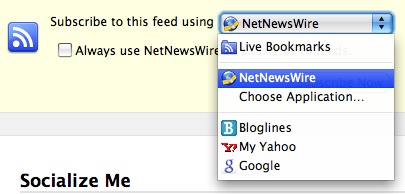
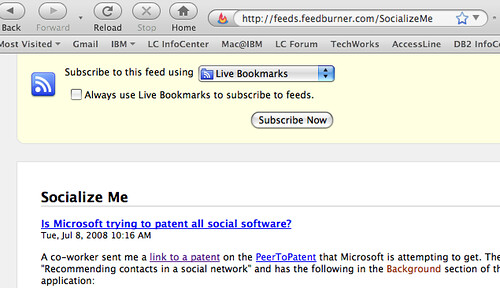
The trick is to actually click on the drop-down for the 'Subscribe Now' button!

200807081546.jpg
Since NetNewsWire is my feed reader I selected it, clicked on 'Always use NetNewsWire to subscribe to feeds.' and voilá! Now, this is what you need to do to subscribe to a feed:
  1. Go to a site, any site
  2. Notice the RSS icon on the browser's address bar
  3. Click on it

Beautiful, huh? (sorry, you can tell I'm still in awe that I didn't discover this sooner!)

And if your application doesn't show up in the drop-down, you can browse your computer for your favorite feed reader. Or you can even add it to Google Reader!

Is Microsoft trying to patent all social software?

View Comments

A co-worker sent me a link to a patent on the PeerToPatent that Microsoft is attempting to get. The title is "Recommending contacts in a social network" and has the following in the Background section of the application:

A social network consists of individuals and their relationships to other individuals. ... The distance (number of relationships) between two individuals within a social network is commonly referred to as their “degree of separation.” ... Because social networks can have hundreds or thousands of individuals and direct relationships, social networks can be very complex. It would be a difficult and time-consuming task to identify individuals and all their relationships within a large social network.

Fortunately, the identity of individuals and their relationships with other individuals can be automatically derived from data stored by computer systems. Many individuals use their computer systems to store indications of relationships to other individuals. In particular, many software applications allow a user to explicitly store names of others with whom the user has a relationship. .... The ... other users are stored in address lists for electronic mail programs, in contact lists for instant messaging programs, in invitation lists for event organizing programs, and so on. In addition, the names of the other users can be derived from data that is not an explicit list. For example, the names of users can be derived from the to, from, and cc fields of electronic mail messages, from meeting entries within a calendar, from letters stored as electronic documents, and so on. Each of these other users has a relationship, referred to as a direct relationship, with the user regardless of the “closeness” of the relationship.

Hmm.. a system that can analyze my social data, my email, and my chat transcripts to figure out how I am interconnected to others within the company... Where have I heard that before... ???? Oh and the system also gives me a visual path to others I may not know? Hmmm... I swear I've heard this story before!! Seems to me like Microsoft is trying to patent Atlas for Lotus Connections. Hopefully, IBM can take some action before Microsoft steals yet another IBM/Lotus idea.


If you are a member of PeerToPatent, give them a mouthful. If you are not a member, sign up today!

Tuesday, July 1, 2008

What's the best industry to sell social software to?

View Comments

A colleague recently approached me and asked me which industry I thought would be best to sell social software to. He explains that in his region, he has a lot of customers in the education industry and they just didn't get it. I had a similar experience before and blogged about it. The question did take me by surprise, so I told him that I would think about it and then blog about it.

First, I had to figure out what were the industries out there. I found this list, but that was way too long. So then, I decided to look at our customer references and see which industries are covered. Here's a summary of them:

Customer Industry Use Case
Bank of NY Banking Link
Imerys Materials Link
Film Foundation Media Link
Saxion Education Link
km.gov Federal Government Link
Sprint Telecommunications Link
-Contstruction Group- Construction/Architecture/Engineering Enhance collaboration / discover tacit knowledge faster
-Software Maker- Computer Services/Consumer Products Provide employees better access to company expertise
-Travel company-Moosejaw Retail Link (Note: Updated 9/12/2008 to disclose name)
University in Brazil in partnership with a college in FL Education Link (Note: Updated 9/12/2008 to add this row)
Video (Note: Updated 11/5/2008 to add this row)
FAA Government Link (Note: Updated 12/13/2008 to add this row)
Aerospace / Automotive Rheinmetall AG Link (Note: Updated 5/8/2009 to add this row

Of course, the list goes on, but I wanted to capture at least 1 example per major industry. As I keep reading about all of our references, some patterns evolve:

  • Each industry has a unique need for social software
  • Most seem to want to enable a better end-user experience
  • Most want to improve collaboration processes, specially those with dispersed/mobile employees

So I don't think the question is valid. Seems to me like everyone needs social software. But who needs it more than others? My guess is that these companies need it more:

  • Companies who need better ways to assemble teams allowing innovation and collaboration to happen
  • Companies with a high-level of turnover or high-number of employees who will soon retire
  • Companies with large number of dispersed and/or mobile employees
  • Companies who would like to build customer and employee loyalty
In fact, a Force Management, online Corporate Social Networking Survey (ended June 6) agrees. It finds that the most significant catalysts for implementing corporate social networks are (in order of importance):
  1. Attracting / Retaining Top Talent
  2. Improved Brand and Culture Experience
  3. Improving Workplace Diversity
  4. Better Access to and Location of Enterprise Knowledge and Expertise
  5. New Sources of Revenue

Do you agree? Did I miss something ?