Lately, I've been thinking about how much work it takes to run a community. Yes, every so often I like to question myself (for those of you who remember when I questioned feed readers). While I didn't get a big reaction for it on my external blog, it certainly caused some buzz in my internal blog.
Running a community takes a lot of work and time
Anyway, as you may know, for two years now, I lead the internal Lotus Social Software community of practice. As the leader I have several responsibilities:
- Host a 1 hr weekly call for Q&A across all members ( 4 hrs / month )
- Welcome new members and introduce them to our tools ( 1 hr / month )
- Create a monthly newsletter with new intellectual capital, happenings, etc ( 3 hrs / month )
- Track unanswered forum threads -- alert SMEs as necessary ( 1-3 hrs / month )
 Of course, these are all self-inflicted responsibilities and nothing dictates that I have to do them. Adding up, in average, I spend ~10-12 hours a month running this community. That seems to me like a lot of time, especially when it seems like the "big buzz" with Enterprise 2.0 and social software is around communities.
Why do I do all of this? Well, based on my experience, communities tend to die if they are not continuously nurtured.
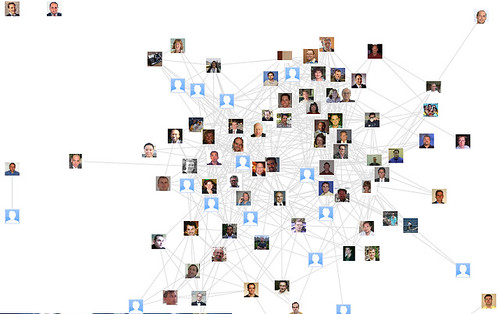
According to Atlas, the network is pretty tight (and you can see me there in the middle!). I'm very proud of that and take some credit for it  .
.
Best Practices for Communities of Practice
Etienne Wenger published in 1998 Communities of Practice - Learning as a Social System in Systems Thinker. Isn't it impressive that something written 11 years ago still applies today!??! Anyway, Wenger is widely recognized as the originator of the term community of practice.
In both of those papers, communities are labeled as self-sufficient / self-organizing. Yet, Wenger emphasizes that communities do benefit from some leadership. He even ends with this quote, which I liked very much:
No community can fully design the learning of another; but conversely no community can fully design its own learning.
Going Forward
I originally started writing this blog entry to help me think "out loud" as to what I should in terms of leading the community. The community, I believe, has been sufficiently "seeded and nurtured". So, is it time to stop "watering the garden" ? Is it time to now let go of the community and let it continue to develop itself ?
I definitely want to continue growing this community and promote the use of social software inside IBM. Therefore, I plan on delegating more responsibilities going forward to distribute the work load across the community core team. But still... running and leading a community takes a lot of work...Are communities really all that ? What do you think?
(from Lynn Busby) – I wholly agree with your statement “communities tend to die if they are not continuously nurtured.”
ReplyDeleteAs the program manager for STG for 30 communities, and from experience with communities before that, I firmly believe that to sustain communities you need a passionate leader, a "pitch in and help" core team, a supportive sponsor and.... a "driver" - someone who knows and cares and nurtures and provides technical support for the community as a community facilitator. I was told that I did a great job of getting the communities back on their feet, but that now there are in "steady state." We'll see, eh?
You are the driving force for your community – and it does take time to orchestrate the activities to keep a community active. Too often, companies rely on the passion of the leader to volunteer above and beyond time for community work. The buzz in Enterprise 2.0 is communities but the bucks do not follow.
Hey Luis,
ReplyDeleteOne of the issues with a community is the leader "hero" scenario - watch out for that. A community needs to be a communal effort. If you notice that you are the only person (or there are only a few of you) doing the heavy lifting, rethink your community activities and ensure they are appropriately collaborative. You of course will see the 'power law distribution' in a community - but make sure it isn't just a handful of people supporting a huge community. So don't pack it in (too important to the organization) just begin to spread the joy :).
Otherwise, people will get used to sitting back and being spoon-fed your newsletter, and ensuring you find answers to their questions unless you ensure others get involved. One way to do that is by getting a larger core team involved, as well as reaching out to others to get them more involved. (People like Luis Suarez and Lynn Busby will have a wealth of examples and techniques). But one of the common issues can be leader burn-out which happens if you do too much. hth
I of course agree with Lynn and Kathryn. However I take personal offense that I am not picture in your network!
ReplyDeleteMac, your the very pale guy with the blue backdrop.
ReplyDeleteCommunities whether through technology or local community centers always need a core group of leaders. People who say communities police them selves, don't get it. While the community needs it's space to grow and form, there always needs to be people looking out for it's best interest.
Luis, you manage the best community at IBM and if you haven't notice, many other community owners are following in your footstep.